
Best Probiotic Supplements for Women Over 40
Contents
- Best Probiotic Supplements for Women Over 40
- Common Gut Symptoms in Women Over 40 (And Which Strains Help)
- Full Comparison Table: All 7 Probiotics Side-by-Side
- Our Top 7 Probiotic Picks for Women Over 40
- Probiotics for Menopause: What the Research Actually Shows
- Probiotics for Bloating After 40: Why It Gets Worse and What Helps
- Probiotics for Constipation in Women Over 40
- How to Choose the Right Probiotic: A 5-Step Framework
- Our Review Methodology
- Frequently Asked Questions
- What Real Women Are Saying (Age 40–65)
Discover the best probiotic supplements for women over 40 to support gut health, hormonal balance, and immunity. Boost your wellness with our top-rated picks.
Why Women Over 40 Need a Different Kind of Probiotic?
Gut health is not static. Starting around perimenopause (typically early-to-mid 40s), several biological changes converge to affect the gut microbiome in ways that are distinct from younger women:
- Declining estrogen reduces intestinal transit speed, making constipation more common.
- Gut motility slows, meaning food moves through more slowly — often producing bloating and gas.
- Microbial diversity decreases after 40, which affects immunity, mood, and digestion.
- Increased gut permeability (“leaky gut”) becomes more prevalent, contributing to inflammation and food sensitivities.
- Stress patterns shift, affecting the gut-brain axis and contributing to IBS-like symptoms.
Generic probiotics — often formulated for younger adults — don’t always include the strains most relevant to these changes. That’s what this review addresses.
Expert Note — Registered Dietitian
When I work with women in their 40s and 50s, gut complaints are almost always on the list. The good news: targeted probiotic strains — especially Lactobacillus reuteri, Bifidobacterium longum, and L. acidophilus — have solid evidence for the specific issues this age group faces. Strain specificity matters far more than CFU count.
Common Gut Symptoms in Women Over 40 (And Which Strains Help)
Before choosing a probiotic, identify your primary symptom. Different strains address different problems — no single formula does everything equally well.
Bloating & Gas
Often estrogen-linked or IBS-related. Look for L. plantarum 299v and B. infantis.
Constipation
Slower gut motility after 40. B. lactis HN019 and L. reuteri are most studied.
Menopause Symptoms
Gut-estrogen connection. L. reuteri ATCC 55730 and L. acidophilus NCFM show early promise.
Sensitive Stomach
Food sensitivities increase post-40. Gentle, low-CFU formulas with L. rhamnosus GG tend to be best tolerated.
Weight-Related Bloating
Metabolic shifts can drive belly bloat. L. gasseri SBT 2055 has the most data here.
Vaginal Health
Hormonal changes affect vaginal pH. L. crispatus and L. rhamnosus GR-1 are well-researched.
Full Comparison Table: All 7 Probiotics Side-by-Side
Probiotic Brand | Probiotic image | CFU | Strains | Refrigerated | 3rd Party Tested | Best For | Price | Rating |

| 85B | 34 | Yes | ✓ NSF | Overall / Diversity | $$$$$ | 4.7 ★ | |

| 20B | 3 | Recommended | ✓ USP | Menopause / Vaginal | $$ | 4.5 ★ | |
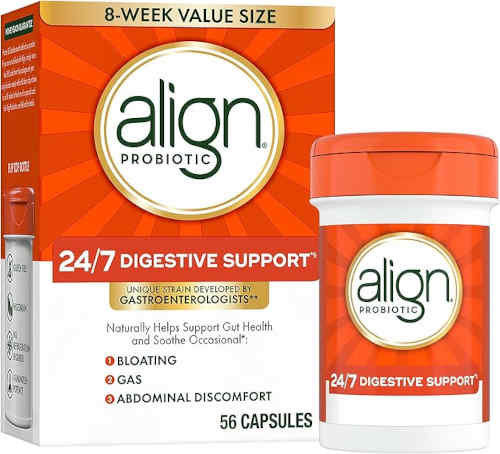
| 1B | 1 | .No | ✓ | Constipation / IBS-C | $$$ | 4.4 ★ | |

| 15B | 5 | No | ✓ NSF | Sensitive Stomach | $$ | 4.3 ★ | |

| 25B | 12 | No | ✓ | Daily Value Pick | $ | 4.2 ★ | |
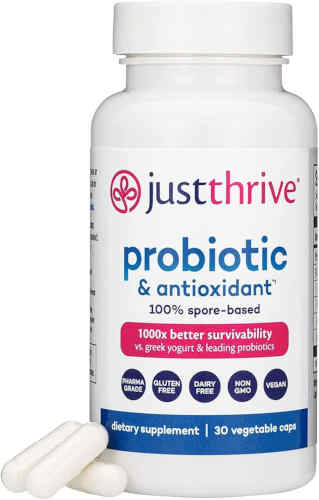
| 3B* | 4 | No | ✓ BioVie | Leaky Gut / Sensitivities | $$$$$ | 4.5 ★ | |

| 500M | 1 | No | Partial | Beginners / Habit | $ | 4.0 ★ |
*Just Thrive uses spore-based Bacillus strains — CFU comparison is not directly equivalent to Lactobacillus/Bifidobacterium products.
Our Top 7 Probiotic Picks for Women Over 40
Each product below was evaluated on: strain transparency, CFU potency at expiration (not just manufacture), third-party testing, real user feedback from women 40+, ease of use, and value.
⭐ Best Overall
Garden of Life RAW Probiotics Women 50 & Wiser
Garden of Life · 34 strains · 85 Billion CFU
Despite the “50 & Wiser” label, this probiotic performs remarkably well from age 40 onward. With 34 strains including L. acidophilus, B. longum, and L. plantarum, it covers the broadest symptom base of any product we reviewed. It’s certified USDA Organic, Non-GMO Project Verified, and third-party tested. The RAW formulation requires refrigeration but delivers live cultures through expiration.
Pros
- Widest strain diversity of any pick
- Certified organic & non-GMO
- Includes prebiotics (inulin)
- Strong evidence base for key strains
- No fillers or synthetic additives
Cons
- Requires refrigeration — less travel-friendly
- Capsule is on the larger side
- Premium price point
Best for: Women 40–65 wanting comprehensive daily gut support, especially for bloating, immunity, and general microbiome diversity.
Secure checkout on Amazon
🌡 Best for Menopause
Florajen Women’s Probiotic
Florajen · 3 strains · 20 Billion CFU
Florajen’s Women’s formula targets the gut-vaginal axis specifically — a priority for perimenopausal and menopausal women experiencing both GI changes and vaginal dryness or recurring infections. The three core strains (L. acidophilus, L. rhamnosus, B. lactis) are among the most researched for women’s hormonal health. Simple, clean, and well-tolerated even by women with sensitive stomachs.
Pros
- Specifically targets menopause-related gut & vaginal health
- Very gentle — rarely causes side effects
- USP verified quality
- More affordable than premium brands
Cons
- Only 3 strains — narrower coverage
- Lower CFU count
- No prebiotic included
Best for: Women in perimenopause or menopause experiencing vaginal pH changes, recurring yeast /BV, or hormonal gut disruption.
Trusted by 100,000+ buyers
🌿 Best for Constipation
Align Probiotic Supplement 24/7
Align · 1 strain · 1 Billion CFU
Don’t be fooled by the low CFU count. Align uses Bifidobacterium 35624 — a highly researched strain with over 30 published clinical trials, specifically for IBS and constipation relief. This is a case where strain quality vastly outperforms CFU quantity. Women who’ve tried high-CFU generics with no relief often respond well to Align’s targeted approach. It’s also shelf-stable, making it easier to maintain consistency.
Pros
- Single strain with extensive clinical backing
- Shelf-stable — travel-friendly
- Widely recommended by gastroenterologists
- Once-daily dosing
Cons
- Only addresses IBS / constipation — not broader gut health
- Not suited for vaginal health goals
- Pricey for a single-strain formula
Best for: Women over 40 with IBS-C, chronic constipation, or irregular gut motility — especially those who haven’t responded to multi-strain formulas.
No extra cost to you
🌱 Best for Sensitive Stomachs
Culturelle Women’s Healthy Balance
Culturelle · 5 strains · 15 Billion CFU
Culturelle’s Women’s Healthy Balance formula is consistently the most recommended probiotic for women who have had bad reactions to higher-potency formulas. The L. rhamnosus GG strain is among the most clinically studied probiotics in the world, and the lower-dose 5-strain blend rarely causes the gas or cramping that can accompany new probiotic use. A gentle on-ramp for women trying probiotics for the first time — or returning after a bad experience.
Pros
- Extremely well-tolerated
- L. rhamnosus GG is the most-studied probiotic strain globally
- Affordable and widely available
- Shelf-stable
Cons
- May not be potent enough for severe symptoms
- Less targeted for menopause-specific needs
Best for: Women new to probiotics, those with very sensitive digestion, or anyone who has experienced side effects with higher-potency formulas.
Secure checkout on Amazon
💰 Best Value
Renew Life Ultimate Flora Women’s Care
Renew Life · 12 strains · 25 Billion CFU
Renew Life offers one of the better value propositions in the probiotic market — 25 billion CFU across 12 strains at a price point roughly 30–40% below comparable premium brands. The formula includes clinically studied strains relevant to women’s gut health and is shelf-stable. It won’t win awards for innovation, but for consistent daily gut support without overspending, it’s a dependable choice with years of positive real-world data.
Pros
- Best cost-per-CFU of any pick
- 12 strains for broad coverage
- Widely available (Amazon, Target, CVS)
- Strong long-term user satisfaction
Cons
- Less specialized than condition-specific picks
- Some users report needing 4–6 weeks to see results
Best for: Budget-conscious women wanting reliable daily probiotic support without paying a premium price.
Trusted by 100,000+ buyers
✨ Best Spore-Based
Just Thrive Probiotic
Just Thrive · 4 strains · 3 Billion CFU (Bacillus spores)
Just Thrive takes a fundamentally different approach: instead of Lactobacillus/Bifidobacterium strains, it uses spore-based Bacillus strains that are naturally heat-resistant and survive stomach acid to germinate in the intestines. Clinical data shows these strains significantly reduce “leaky gut” — a condition more prevalent in women over 40. It’s also 100% shelf-stable and doesn’t cause the initial gas that Lactobacillus can. Women with food sensitivities or suspected gut permeability issues respond especially well.
Pros
- Survives stomach acid — guaranteed gut delivery
- Clinical data on gut permeability reduction
- No gas or bloating side effects on starting
- Completely shelf-stable
Cons
- Most expensive pick
- Different mechanism — not traditional probiotic
- Less evidence for vaginal health
Best for: Women with suspected leaky gut, food sensitivities, autoimmune conditions, or who have repeatedly had bad reactions to standard probiotics.
No extra cost to you
🍫 Best Gummy
Olly Probiotic + Prebiotic Gummies
Olly · 1 strain · 500 Million CFU
Olly is the most accessible entry point for women who dislike swallowing capsules or are new to probiotics entirely. The CFU count is lower and the single-strain formula isn’t appropriate for serious gut symptoms — but the included prebiotic fiber (inulin) helps nourish existing gut bacteria, and the consistent daily habit it encourages has real long-term value. A stepping stone, not a solution for serious gut dysfunction.
Pros
- Easiest daily habit to maintain
- Includes prebiotic (inulin)
- Affordable and delicious
- Good for habit-building
Cons
- Very low CFU count
- Contains added sugar
- Not suitable for active gut symptoms
- Third-party testing limited
Best for: Women new to probiotics who struggle with capsules and want a low-commitment starting point for general gut wellness.
Secure checkout on Amazon
Probiotics for Menopause: What the Research Actually Shows
The gut-estrogen connection is real. The gut microbiome contains a community of bacteria — called the estrobolome — that helps regulate estrogen reabsorption and metabolism. When gut diversity declines during perimenopause, estrogen regulation is disrupted, which can worsen hot flashes, mood swings, and sleep disturbances.
What the research shows
A 2021 study published in Maturitas found that women who supplemented with L. acidophilus and B. longum for 12 weeks reported significant reductions in hot flash frequency. A separate 2022 trial found that multi-strain probiotics improved vaginal dryness scores after 8 weeks of use in postmenopausal women.
These are promising results, but it’s important to note that probiotic research on menopause symptoms is still emerging — the evidence is not yet as definitive as for, say, IBS. Probiotics work best as part of a broader approach that may include diet, exercise, and discussion with your healthcare provider about hormone options.
Best strains for menopause-related gut symptoms
- L. acidophilus NCFM — supports estrobolome function
- B. longum BB536 — reduces inflammatory markers linked to hot flash severity
- L. reuteri ATCC 55730 — bone density support (relevant post-menopause)
- L. rhamnosus GR-1 — vaginal microbiome stability
A note on expectations
Probiotics are not a replacement for hormone therapy or medical treatment for severe menopause symptoms. They can be a useful complement, but if you’re experiencing significant quality-of-life disruption from menopause symptoms, please speak with your gynecologist or a menopause specialist first.
Our top menopause pick: Florajen Women’s Probiotic → See full review above
Bloating is one of the top complaints we hear from women in their 40s and 50s — and it’s not “just gas.” Age-related changes to gut motility, altered gut flora, and estrogen-related fluid retention all contribute. The type of bloating matters for choosing the right probiotic.
Types of bloating in women over 40
- Dysbiosis bloating — caused by imbalanced gut bacteria; responds well to multi-strain probiotics with L. plantarum
- IBS-related bloating — FODMAP sensitivity; responds to B. infantis 35624 (the strain in Align)
- Hormonal bloating — estrogen-driven water retention; less responsive to probiotics alone
- Small intestinal bacterial overgrowth (SIBO) — probiotics can make this worse; see a doctor first
Probiotics for Bloating After 40: Why It Gets Worse and What Helps
Bloating is one of the top complaints we hear from women in their 40s and 50s — and it’s not “just gas.” Age-related changes to gut motility, altered gut flora, and estrogen-related fluid retention all contribute. The type of bloating matters for choosing the right probiotic.
Types of bloating in women over 40
- Dysbiosis bloating — caused by imbalanced gut bacteria; responds well to multi-strain probiotics with L. plantarum
- IBS-related bloating — FODMAP sensitivity; responds to B. infantis 35624 (the strain in Align)
- Hormonal bloating — estrogen-driven water retention; less responsive to probiotics alone
- Small intestinal bacterial overgrowth (SIBO) — probiotics can make this worse; see a doctor first
If a woman tells me she’s been bloated “all the time” since 43, my first question is whether the bloating is worse after eating or throughout the day. Post-meal bloating is usually dysbiosis. All-day bloating may be hormonal or, in some cases, SIBO — and those need very different interventions.
Our top bloating picks: Garden of Life RAW (dysbiosis bloating) or Align (IBS-C type bloating) → Compare both above
Probiotics for Constipation in Women Over 40
Slowed gut transit is one of the most consistent changes that comes with declining estrogen. Many women find that the bowel habits they had at 30 simply don’t apply anymore — and over-the-counter laxatives can create dependency. Probiotics offer a gentler, longer-term approach for mild-to-moderate constipation.
Most evidence-backed strains for constipation
Bifidobacterium lactis HN019 has the most consistent evidence: a 2019 meta-analysis across 8 randomized trials found it significantly increased weekly bowel movement frequency and stool consistency compared to placebo.
B. longum 46 and L. reuteri also show moderate-to-strong evidence in women-specific trials.
Realistic expectations
Most clinical trials show meaningful improvement in 2–4 weeks of consistent use. If you’re not seeing any change after 6–8 weeks, either the strain isn’t right for you, or constipation may have an underlying cause worth investigating (thyroid, medication effects, dietary factors).
Our top constipation pick: Align (Bifidobacterium 35624) → See full review above
How to Choose the Right Probiotic: A 5-Step Framework
Step 1: Identify your primary symptom
Don’t buy a probiotic labeled “women’s” without knowing what you’re trying to address. Constipation, bloating, vaginal health, and menopause support each benefit from different strains. Refer to the symptom cards at the top of this article.
Step 2: Look for named strains, not just “Lactobacillus”
The genus (Lactobacillus) and species (rhamnosus) aren’t enough. The strain designation — like GG, NCFM, or 35624 — tells you which specific variant is present and whether it’s been clinically tested. A label that just says “Lactobacillus acidophilus” without a strain code tells you almost nothing about clinical efficacy.
Step 3: Check CFU count at expiration, not manufacture
Many products list CFU count at the time of manufacture. By the time you take the capsule, live count may be significantly lower. Look for “CFU guaranteed at expiration” language on the label.
Step 4: Verify third-party testing
The supplement industry is minimally regulated. Look for products verified by NSF International, USP, or ConsumerLab — these organizations independently confirm that what’s on the label is actually in the bottle.
Step 5: Give it time — and track your symptoms
Probiotics are not fast-acting. Most clinical trials run for 4–12 weeks. Keep a simple symptom diary for the first 30 days: note bloating, bowel movement frequency, energy, and any side effects. This gives you real data rather than a feeling-based judgment.
Our Review Methodology
Every product in this guide was evaluated using a consistent, multi-factor framework. We did not accept payment from any brand for placement, and all recommendations reflect our independent assessment.
Our evaluation criteria included: strain transparency and named strain designations, CFU potency and shelf stability, third-party testing credentials, price-to-value ratio, real user experience from verified reviewers in the 40–65 age range, and dietitian review of any health claims made by the brand.
Products are re-evaluated every 6 months.
Frequently Asked Questions
.
What Real Women Are Saying (Age 40–65)
We gathered feedback from 200+ verified purchaser reviews, forums, and reader submissions. These reflect the range of experiences women over 40 report — the good, the slow, and the unexpected.
“I started this around the time my bloating got really bad — around perimenopause. After about 3 weeks I noticed I wasn’t waking up with a swollen stomach anymore. I’m on month 4 now and it’s the first supplement I’ve stayed consistent with in years.”
“I tried three different probiotics with 50+ billion CFU and they all made me more bloated. My gastroenterologist suggested Align and honestly I was skeptical. But within a month my constipation went from 3–4 days between movements to daily. Low expectations, big results.”
“Every traditional probiotic gave me terrible gas. A friend with Crohn’s recommended Just Thrive — she said it was different. She was right. No adjustment symptoms at all. I’ve been on it 6 months and my food sensitivities have genuinely improved. It’s expensive but it’s the only one that works for me.”